
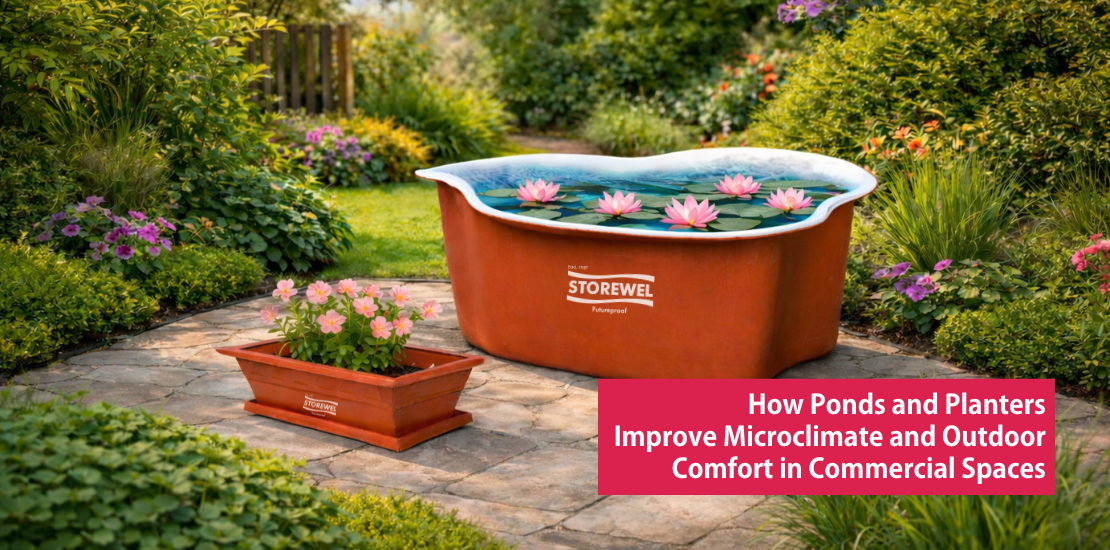
As urban development intensifies, commercial and public spaces are facing a growing challenge: maintaining outdoor comfort in increasingly warm, dense environments. From corporate campuses and business parks to hospitals, hotels and institutional premises, outdoor areas are no longer optional amenities. They are active zones used for movement, interaction and relaxation.
In this context, ponds and planters are evolving from decorative landscape elements into functional tools for microclimate management.
Understanding Microclimate in Built Environments
A microclimate refers to the localised atmospheric conditions of a specific area. In commercial developments, factors such as concrete surfaces, limited greenery and heat-absorbing materials often create higher ambient temperatures, commonly known as the urban heat effect.
Poorly managed outdoor microclimates lead to:
- Reduced usability of open spaces
- Increased discomfort for employees, visitors and residents
- Higher cooling demand in adjacent indoor areas
Designing outdoor environments that actively regulate temperature has become a priority for architects, developers and facility managers.
Role of Ponds in Temperature Regulation
Water bodies naturally cool surrounding air through evaporation. In commercial spaces, ponds help moderate temperature by absorbing heat during the day and releasing it gradually, reducing sharp temperature fluctuations.
Well-placed ponds contribute to:
- Lower surrounding surface temperatures
- Improved air movement and humidity balance
- A calmer, more comfortable outdoor atmosphere
Beyond climate benefits, ponds also enhance visual comfort, which positively impacts user experience and perceived space quality.
However, for ponds to function effectively over time, durability and water retention are essential. Poorly constructed ponds often suffer from leakage, stagnation and maintenance challenges, which undermine both environmental and operational benefits.
How Planters Support Thermal Comfort and Air Quality
Planters play a complementary role by introducing vegetation into hardscaped environments. Plants provide shade, reduce heat reflection and improve air circulation.
Strategically placed planters help:
- Reduce heat absorption on paved surfaces
- Improve thermal comfort in walkways and seating areas
- Enhance visual relief in dense developments
In commercial spaces where ground landscaping is limited, planters become a practical way to integrate greenery without structural changes.
Durability is critical here as well. Planters exposed to sun, rain and daily handling must maintain structural stability and appearance to remain effective over time.
Why Design and Material Choice Matter
The microclimate benefits of ponds and planters depend heavily on their design and material performance. Cracking, fading or leakage not only increases maintenance but also reduces effectiveness.
Durable, weather-resistant ponds and planters ensure:
- Consistent water retention and plant health
- Reduced maintenance intervention
- Long-term performance in outdoor conditions
Lightweight yet strong designs also allow flexibility in layout, enabling facility teams to adapt spaces as usage patterns evolve.
Why Commercial Spaces Choose Storewel Ponds and Planters
For organisations seeking long-term value, Storewel offers pond and planter solutions designed for real outdoor conditions.
Storewel solutions support microclimate management by offering:
- Durable construction suitable for prolonged outdoor exposure
- Reliable water retention and structural stability
- Ease of installation and repositioning
- Low maintenance and long service life
- Consistent performance across commercial and public environments
By combining practical design with long-lasting materials, Storewel helps businesses create outdoor spaces that are not only visually appealing but also comfortable and functional.
Conclusion
In modern commercial environments, outdoor comfort is directly linked to usability, sustainability and overall property value. Ponds and planters, when selected thoughtfully, play a vital role in shaping microclimates that support people, operations and long-term efficiency.
By choosing durable, low-maintenance solutions, organisations can transform outdoor areas into assets rather than liabilities. Storewel ponds and planters help achieve this balance, supporting smarter, more comfortable spaces for today’s urban environments.