
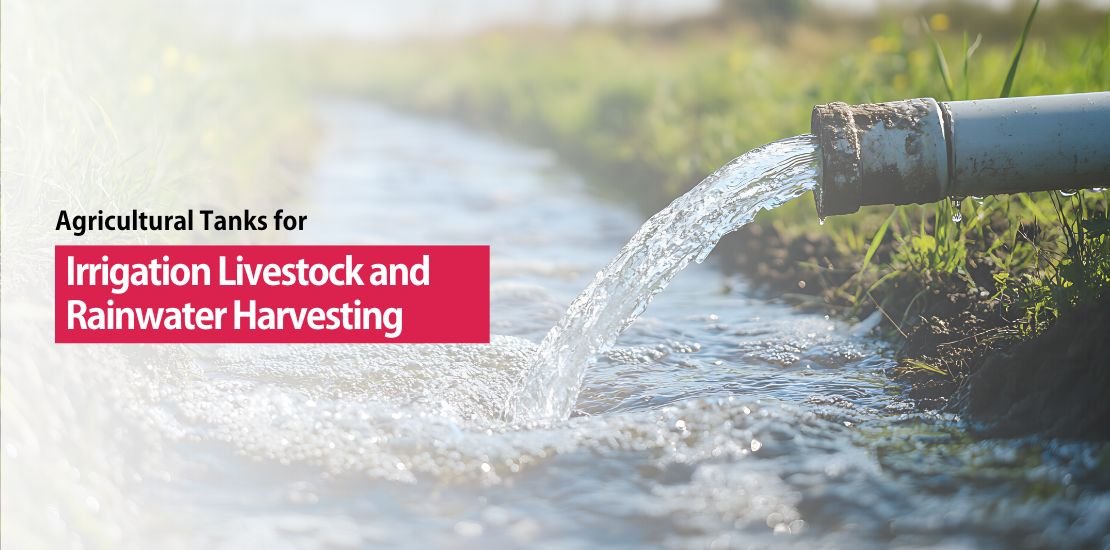
Reliable Water Storage for Irrigation Livestock and Rainwater Use
Agricultural tanks play a central role in modern farming systems where water availability, reliability and storage hygiene directly affect productivity. From irrigation and livestock care to rainwater harvesting farmers today depend on durable storage solutions that can perform consistently across seasons. As agriculture moves toward planned water use and reduced dependency on unpredictable rainfall, agricultural tanks have become a critical part of farm infrastructure.
Role of agricultural tanks in irrigation management
Irrigation is the backbone of crop production especially in regions with irregular rainfall. Agricultural tanks provide a reliable buffer that allows farmers to store water during availability and use it when crops need it most. Stored water supports scheduled irrigation cycles instead of reactive watering which often leads to wastage or crop stress.
Tanks are commonly used for surface irrigation, drip irrigation and sprinkler systems. In drip irrigation setups tanks act as a holding point for clean water and nutrient mixed solutions ensuring controlled delivery to the root zone. This improves water efficiency, reduces runoff and supports uniform crop growth. Large capacity agricultural tanks are also used to stabilize supply in canal fed or borewell based irrigation systems where direct pumping may not be consistent.
Supporting livestock water requirements
Livestock operations require continuous access to clean water for drinking, washing and basic farm hygiene. Agricultural tanks ensure uninterrupted supply even during power outages or seasonal shortages. Cattle poultry and dairy farms often rely on storage tanks to maintain daily consumption levels without stressing groundwater sources.
Properly designed tanks help prevent contamination and algae growth which is critical for animal health. Smooth internal surfaces and closed storage designs reduce the risk of bacterial buildup. Tanks can also be positioned strategically across large farms to reduce manual labour and ensure animals do not travel long distances for water which directly impacts productivity and weight gain.
Importance of rainwater harvesting in agriculture
Rainwater harvesting has gained importance as groundwater levels continue to decline. Agricultural tanks allow farmers to capture and store rainwater from rooftops, greenhouses, farm sheds and open catchment areas. This harvested water can be reused for irrigation, livestock washing and even soil preparation.
Storing rainwater reduces dependency on external water sources and helps manage water costs over time. It also minimizes soil erosion and runoff during heavy rains. When combined with filtration systems agricultural tanks can store relatively clean water suitable for multiple farm uses. Seasonal rainwater storage is especially useful for dry spells that occur between monsoons.
Material durability and long term performance
Agricultural environments expose tanks to sunlight soil contact temperature variation and repeated filling and emptying cycles. This makes material strength and stability essential. Tanks must resist cracking deformation and degradation over time. Rotationally moulded tanks are commonly used due to their seamless construction and uniform wall thickness which improves durability.
A stable tank structure ensures that water quality remains consistent and that storage capacity does not reduce due to bulging or leaks. This reliability is critical for farms that depend on stored water for daily operations rather than backup use.
Storewel perspective on agricultural water storage
Storewel has been associated with manufacturing rotationally moulded storage solutions designed to meet practical agricultural requirements. Their tanks are used across irrigation storage, livestock water management and rainwater harvesting applications. The focus is on providing strong structures that can handle outdoor exposure and repeated use without compromising water safety.
Storewel agricultural tanks are designed to support farming environments where maintenance access may be limited. The stable body structure and smooth interiors help reduce cleaning effort and long term wear. While the primary role of agricultural tanks remains functional water storage, Storewel aligns its designs to support reliable farm operations rather than short term solutions.
Integrating tanks into modern farm planning
Modern agriculture increasingly involves planned layouts where water storage is integrated with crop cycles, livestock zones and harvesting systems. Agricultural tanks act as central nodes connecting borewells, rainwater collection points and irrigation networks. Proper sizing and placement of tanks helps reduce pumping energy and manual handling.
Using multiple tanks instead of a single large storage unit also improves flexibility. Farmers can dedicate tanks for specific uses such as irrigation nutrient mixing livestock supply or rainwater storage. This segregation improves water management and reduces cross contamination.
Conclusion
Agricultural tanks are no longer optional components of farming infrastructure. They directly influence water efficiency, livestock health, crop yield and long term sustainability. Whether used for irrigation livestock or rainwater harvesting the right storage system supports stable farm operations across seasons.
As agriculture continues to adapt to water scarcity and operational efficiency well designed agricultural tanks supported by manufacturers like Storewel contribute to dependable water management without adding complexity. Choosing durable storage solutions helps farms stay resilient, productive and prepared for changing environmental conditions.